


6sense HQ vs DevToDollars: Best MVP Partner in 2026
Compare 6sense HQ and DevToDollars on MVP speed, team models, proof, pricing, and post-launch support to pick the right fit.
15 min read
Avoid common MVP development pitfalls. Learn how to prioritize features, validate ideas, and build a successful startup product.
Written by: AKM Ahsan Created on: 8 Apr 202616 min to read

Many startups spend months building a product they believe people will love. Then they launch it and almost nobody uses it. Understanding what an MVP means in software development can help founders avoid this situation by allowing them to test a focused version of their product before committing to full-scale development. The problem is often not the idea itself, but how the first version of the product was built. This is where the concept of a Minimum Viable Product (MVP) becomes important.
At 6sense HQ, we have worked with dozens of early-stage startups trying to validate their product ideas quickly without wasting development budgets. Across these projects, we repeatedly see the same MVP development challenges appear in the first few weeks of product planning and development. This experience also shows why developing an MVP is so important for startups. It gives founders an opportunity to validate their assumptions, control development costs, and learn from real users before investing in a complete product.
But building an MVP is harder than it sounds. Founders often rush development, guess what users want, or add too many features too early. These mistakes can waste time, drain budgets, and lead to products that never gain real traction in the market.
The most common MVP development challenges include feature creep, weak market validation, poor prioritization, slow development cycles, and ignoring real user feedback. In this guide, we break down each challenge and show practical ways founders can solve them.
One of the biggest mistakes founders make is building an MVP based on assumptions rather than real market research. Many entrepreneurs fall in love with their idea and rush into development without understanding whether users actually need the product.
When founders skip market validation, they often build features that nobody asked for. This leads to wasted development time, higher costs, and poor product adoption.
Startup leaders have warned about this mistake for years. Steve Jobs once said,
This advice is supported by startup failure data. According to CB Insights analysis of startup post-mortems, about 42% of startups fail because they build products with no real market need.
Without proper research, an MVP becomes just another unfinished product rather than a tool to validate an idea.
Building an MVP sounds simple in theory, but real founders often face unexpected challenges during development. These issues appear repeatedly across real startup experiences and product discussion.
In our experience building MVPs at 6sense HQ, this misunderstanding appears early in product discussions. Founders often interpret “minimum” as releasing something unfinished or broken rather than something focused but useful.
An MVP still needs to provide value to users. When the product feels confusing or unreliable, early users quickly lose trust and stop using it.
Teams rush to release something quickly and remove too many features without considering the user experience.
Focus on delivering one complete user outcome, not just a set of stripped-down features. For example, instead of launching a messaging product with half-working chat functions, launch with one reliable messaging workflow that users can fully complete.
Feature creep is one of the most common MVP pitfalls we see when founders start expanding their roadmap during development.
Teams often begin with a simple idea but keep adding “just one more feature.” This slowly turns the MVP into a full product, increasing development cost and delaying launch.
Stakeholders want to solve every possible problem in the first release.
Adopt strict feature prioritization frameworks such as:
| Framework | How It Works |
| MoSCoW Method | Classifies features into Must Have, Should Have, Could Have, and Won’t Have |
| RICE Framework | Scores features using Reach × Impact × Confidence ÷ Effort |
Example: A feature that reaches 5,000 users but requires 3 months of development may score lower than a smaller feature that solves a critical user problem.
This slowly turns the MVP into a full product, increasing MVP development costs, delays, and development complexity.
Many MVPs fail because the product tries to solve too many problems at once.
Successful MVPs usually focus on solving one specific problem extremely well.
Founders attempt to serve multiple audiences in their first version.
Define your primary user and primary pain point.
Ask three questions:
If the MVP does not clearly answer these questions, the product will likely struggle.
Some founders rely only on their own ideas instead of talking to real users. This leads to building features people don’t need.
Founders assume their own experience represents the broader market.
Validate ideas before building by using:
These methods help founders validate demand before writing a single line of code.
Speed is critical in startup environments. However, many teams spend months perfecting small details before launching.
Teams try to build production-level infrastructure too early.
Use short development cycles such as Agile sprints and adopt the Build–Measure–Learn loop.
Launch early → gather feedback → improve.
One of the key advantages of developing an MVP is that startups can collect useful feedback sooner, make improvements based on real usage, and reduce the financial risk of building unnecessary features.
This allows startups to validate their idea quickly and reduce development risk.
Another challenge is deciding which features truly matter.
Without clear prioritization, development becomes chaotic and teams spend time building features that do not contribute to the product’s main value.
Founders struggle to say “no” to new ideas.
Use a problem-first roadmap.
Instead of asking “What feature should we build next?”, ask:
“Which feature reduces the biggest user friction right now?”
This approach keeps development focused on real outcomes.
MVP development works best when startups launch early and improve the product step by step. Many founders delay launching their MVP because they think the product is not perfect yet.
However, waiting too long removes the opportunity to learn from real users.
Fear of negative feedback.
Define clear launch criteria, such as:
| Challenge | Root Cause | Fix |
| Misunderstanding MVP | Focus on “minimum” instead of value | Deliver one complete user outcome |
| Feature creep | Adding too many features | Use MoSCoW or RICE frameworks |
| Unclear core problem | Trying to serve many audiences | Focus on one user persona |
| No user validation | Building on assumptions | Conduct interviews and prototype testing |
| Slow development cycles | Overengineering early | Use Agile sprints and fast iterations |
| Poor prioritization | Lack of decision framework | Use problem-first roadmap |
| Delayed launch | Fear of imperfection | Define launch readiness criteria |
Building an MVP becomes harder when founders, investors, developers, designers, and business teams all have different expectations. Some people may want speed, some may want more features, and some may want a polished product. That is why stakeholder alignment should happen throughout the MVP lifecycle, not only at the beginning.
An MVP is not a broken or unfinished product. It is also not the full version of your startup idea. It is the simplest useful version that helps test one core assumption. Everyone involved should understand this clearly before development starts, so the team does not overbuild or underdeliver.
Stakeholders should not disappear after the first planning meeting. Regular check-ins help founders, product teams, and decision-makers stay aligned on progress, blockers, feedback, and changing priorities. These meetings do not need to be long. Even a short weekly review can prevent confusion and reduce last-minute changes.
A shared roadmap helps everyone see what is being built now, what will come later, and what is out of scope for the MVP. Tools like Jira, Trello, Notion, or a simple shared document can work. The goal is to avoid scattered decisions across chats, calls, and private notes.
Too many opinions can slow MVP development. Before work begins, decide who has final authority over product scope, design approval, technical trade-offs, and launch readiness. This makes decision-making faster and helps the team avoid endless debates when priorities change during development.
User feedback should not stay only with the founder or product manager. Developers, designers, and stakeholders should also see what users are saying. This keeps the team focused on real problems instead of personal opinions. It also helps everyone understand why certain features should be added, changed, or removed.
Learning from real startup failures helps founders avoid repeating the same mistakes.
Juicero raised over $100 million to sell a Wi-Fi-enabled juicer that squeezed proprietary fruit packets. However, users later discovered they could squeeze the packets by hand. The product solved no real problem and collapsed quickly.
Key lesson: Validate whether the problem truly exists before building complex solutions.
Quibi launched a mobile streaming platform with billions in funding but failed within months because its format didn’t match how people actually consumed video content.
Key lesson: Understanding real user behavior is more important than building sophisticated technology.
Google Glass was an innovative product but lacked a clear everyday use case and raised privacy concerns.
Key lesson: Innovation alone is not enough. The product must solve a clear problem for a large audience.
MVP success does not come from building the biggest first version. It comes from building the right first version, launching it to real users, and learning quickly. The best MVP teams stay focused, avoid unnecessary features, and use feedback to improve the product step by step.
A strong MVP starts with one specific problem, not a long list of ideas. Founders should clearly define who the product is for, what pain point it solves, and why users need it now. When the problem is clear, feature decisions become easier and development stays focused.
The MVP should help users complete one meaningful task from start to finish. It does not need every advanced feature, but the main workflow should feel useful and reliable. For example, a booking MVP should let users search, choose, and confirm a booking without confusion.
Successful founders test ideas before spending heavily on development. This can be done through interviews, landing pages, clickable prototypes, waitlists, or manual service tests. These early signals help founders understand whether users actually care before building a full product.
A successful MVP does not wait for perfection. It launches when the core workflow works well enough for early users. After launch, the team should track feedback, usage data, bugs, drop-offs, and repeated complaints. These signals show what needs to improve next.
After launch, the team should not build every requested feature immediately. Some feedback is useful, and some is not. The best teams look for patterns in user behavior, support requests, interviews, and analytics. This helps them improve the product based on real evidence.
Many MVPs fail because they become too complex too early. Successful teams keep the product lean until the market proves what matters. They add features only when there is a clear reason, such as user demand, revenue potential, retention improvement, or operational need.
Rushing MVP development often leads to shortcuts in architecture.
These shortcuts create technical debt, making future scaling difficult.
Solution: Use simple but scalable architecture patterns and document decisions early.
Choosing the wrong technology stack can slow development and limit scalability.
Solution: Select tools based on speed of iteration, developer availability, and future scalability.
Some startups build an MVP but never plan how users will discover it.
Solution: Combine MVP launch with:
Choosing the right features for an MVP is one of the hardest decisions founders face.
| Category | Meaning | Example |
| Must Have | Essential features | User registration |
| Should Have | Important but not critical | Email notifications |
| Could Have | Nice to include | UI customization |
| Won’t Have | Not needed for MVP | Advanced analytics |
RICE = Reach × Impact × Confidence ÷ Effort
Example:
Feature A Reach: 1000 users Impact: 3 Confidence: 80% Effort: 4 weeks
RICE Score = (1000 × 3 × 0.8) / 4
Higher scores get built first.
Choosing the right features for an MVP is one of the hardest decisions for founders. Many startups either build too much or launch something that feels incomplete. The key is focusing on features that solve one core user problem.
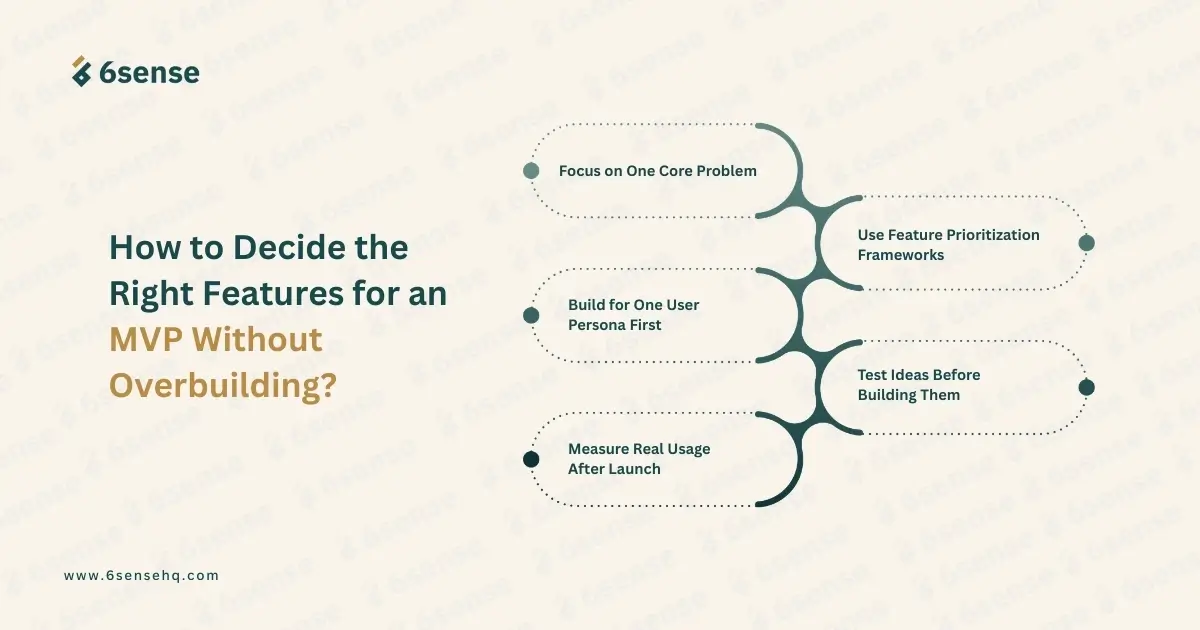
Every successful MVP solves one main problem for users. Instead of trying to solve many issues at once, founders should clearly define the most urgent problem their product addresses and build features only around that specific need.
MVP Frameworks like MoSCoW or RICE help founders prioritize features based on impact and effort. These methods make it easier to decide which features are essential for the first version and which can wait for later updates.
Trying to serve multiple audiences in the first version often leads to feature overload. Many successful founders recommend building the MVP for a single user type first. This makes it easier to design simple and focused features.
Not every idea needs to be coded immediately. Founders can validate feature ideas using prototypes, landing pages, or user interviews. However, it is important to understand the differences between an MVP, a proof of concept, and a prototype. A proof of concept checks whether an idea is technically feasible, a prototype demonstrates how the product may look or work, while an MVP is a functional version released to real users for market validation.
This helps teams avoid spending weeks building features that users might never use.
Even well-planned features may not work as expected. After launching the MVP, founders should track which features users actually use. This data helps guide future product development and prevents unnecessary feature expansion.
The whole purpose of building an MVP is to learn from real users. When startups ignore feedback, they lose the biggest advantage of launching early.
User feedback reveals how people actually use the product, what problems they face, and which features they value most. Without this information, founders rely only on assumptions instead of real insights.
Many successful startups improved their products through early user feedback and continuous iteration.
Customer insights also play a direct role in improving product success. Studies show that 78% of customers prefer brands that actively collect and use feedback when improving their products or services.
Listening to users helps founders adjust their product direction quickly and avoid building features that do not solve real problems.
Startups rarely have unlimited resources. Limited budget, small teams, and lack of experience can create major challenges during MVP development. The table below highlights some common problems and their impact.
| Challenge | How It Affects MVP Development |
| Limited Budget | Forces teams to cut features or delay development. |
| Small Development Team | Slower development and limited technical expertise. |
| Lack of Product Experience | Poor feature prioritization and unclear product vision. |
| Time Pressure | Teams rush development and overlook testing. |
| Technical Skill Gaps | Poor architecture decisions that cause future problems. |
| Weak Project Management | Development becomes disorganized and inefficient. |
Before launching your MVP, ask:
If the answer to most of these questions is yes, your MVP is likely ready.
Choosing the right MVP development service is important because the wrong partner can waste time, budget, and product momentum. A good MVP partner should not only write code. They should help you clarify the idea, reduce unnecessary scope, build fast, and learn from real users.
A strong MVP development partner should ask questions before giving a price. They should want to understand your users, business model, core problem, and launch goal. If a team only says yes to every feature without questioning priorities, they may build what you ask for, not what your startup actually needs.
Ask how they move from idea to launch. A good team should have a clear process for discovery, feature prioritization, UI/UX design, development, testing, launch, and feedback collection. If the process feels unclear, the project may become disorganized once development begins.
You do not need to commit to a huge build immediately. Start with a discovery phase, clickable prototype, technical plan, or small pilot project. This helps you test the team’s communication, speed, quality, and problem-solving ability before spending a larger budget.
Great MVP development services help founders decide what should be built now and what should wait. They should be comfortable using prioritization methods like MoSCoW, RICE, or a simple impact-versus-effort approach. This protects the MVP from feature creep and wasted development time.
Good communication is one of the biggest signs of a reliable MVP team. Ask how often they provide updates, what tools they use, who your main contact person will be, and how they handle changes. Regular updates help you stay involved without managing every small technical task.
An MVP needs both usability and technical stability. The product does not need to be perfect, but users should understand how to use it, and the main workflow should work reliably. A good team balances design, development, QA, and performance instead of focusing only on fast coding.
MVP development does not end on launch day. After users start using the product, you will need fixes, improvements, feedback analysis, and new feature decisions. Choose a team that can support the product after launch, not one that disappears once the first version is delivered.
Building a successful MVP is not just about launching a simple product. It requires clear problem definition, strong market research, and careful feature prioritization. Many startups struggle because they rush development, ignore user feedback, or try to build too many features at once.
The most successful MVPs focus on solving one problem well and learning from early users. Startups that listen to feedback and iterate quickly often find product-market fit faster and avoid wasting valuable MVP time and resources.
At 6sense HQ, we help startups move from idea to working MVP quickly while avoiding these common development traps.
If you want guidance on building your first MVP, talk to our product experts at 6sense HQ.
Compare 6sense HQ and DevToDollars on MVP speed, team models, proof, pricing, and post-launch support to pick the right fit.
15 min read

Compare 6sense HQ alternatives for MVP development in 2026 and find the best software team for your startup budget and goals.
17 min read

Learn whether one developer can build an MVP in 2026 with cost, scope, AI tools, low-code tips, risks, and launch advice.
22 min read