


6sense HQ vs DevToDollars: Best MVP Partner in 2026
Compare 6sense HQ and DevToDollars on MVP speed, team models, proof, pricing, and post-launch support to pick the right fit.
15 min read
Stop wasting money on products nobody wants! Learn how MVP development saves your startup from the "Assumption Trap" and fuels growth.
Written by: AKM Ahsan Created on: 13 Apr 20268 min to read

MVP development helps startups validate their ideas, reduce development costs, and avoid building products no one wants. It is the fastest way to test real demand before committing to full product development.
If you are building a startup, the real risk is not failure itself. It is failing after months of software development with nothing to show for it. Many founders still treat the minimum viable product as optional or rush through it, assuming speed matters more than validation. In reality, skipping this step often leads to wasted time, money, and missed chances to validate what users actually need.
In this guide, you will learn why MVP development is critical, what happens when you skip it, and how it protects your startup from costly mistakes.
Before understanding why MVP development matters, you need to be clear on what an MVP actually is. Many founders misunderstand the concept and treat it as a shortcut, which leads to poor results.
Understanding what an MVP means in software development begins with recognizing that it is more than a basic or unfinished product. A minimum viable product is the simplest working version of your product that helps you validate your core idea with real users. It is intentionally focused on solving one key problem and testing whether that problem is worth solving.
To choose the correct validation method, founders must understand how an MVP differs from a proof of concept and a prototype. Although all three are used during the early stages of product development, each one answers a different question and produces a different type of insight:
| Approach | Purpose | Key Question Answered |
| Proof of Concept | Test technical feasibility | Can we build this? |
| Prototype | Test design and flow | What will it look like? |
| MVP (Minimum Viable Product) | Test market demand | Do users actually want this? |
If you skip MVP development, you are not saving time. You are taking a bigger risk with your startup. Building a full product without validation turns product development into expensive guesswork instead of a learning process.
Here are the three most common traps founders fall into:
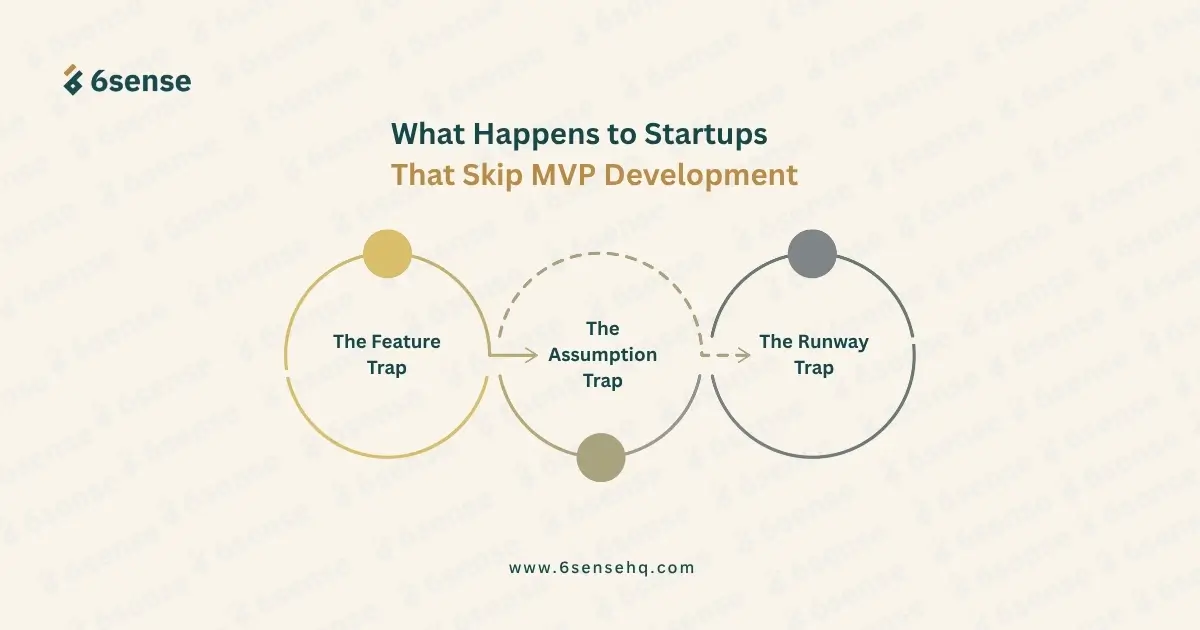
Without MVP thinking, teams try to build everything at once. They add features based on assumptions rather than real user needs. Over time, this leads to feature bloat, higher software development effort, and a product that becomes harder to manage.
The problem is simple. You are building before you validate.
What makes sense inside your team may not make sense to users. Founders often believe their idea is obvious or valuable without testing it in the real world.
Without early iteration and feedback, your startup risks building something that users do not actually want.
This is where it becomes dangerous. By the time the product launches, most of your budget is already spent. If the product fails to gain traction, there is little room left to pivot or improve.
Skipping MVP development does not remove risk. It delays it until it becomes more expensive to fix.
If you’re serious about building a successful startup, MVP development is not optional. It directly impacts how you validate your idea, manage risk, and move toward a product users actually want.
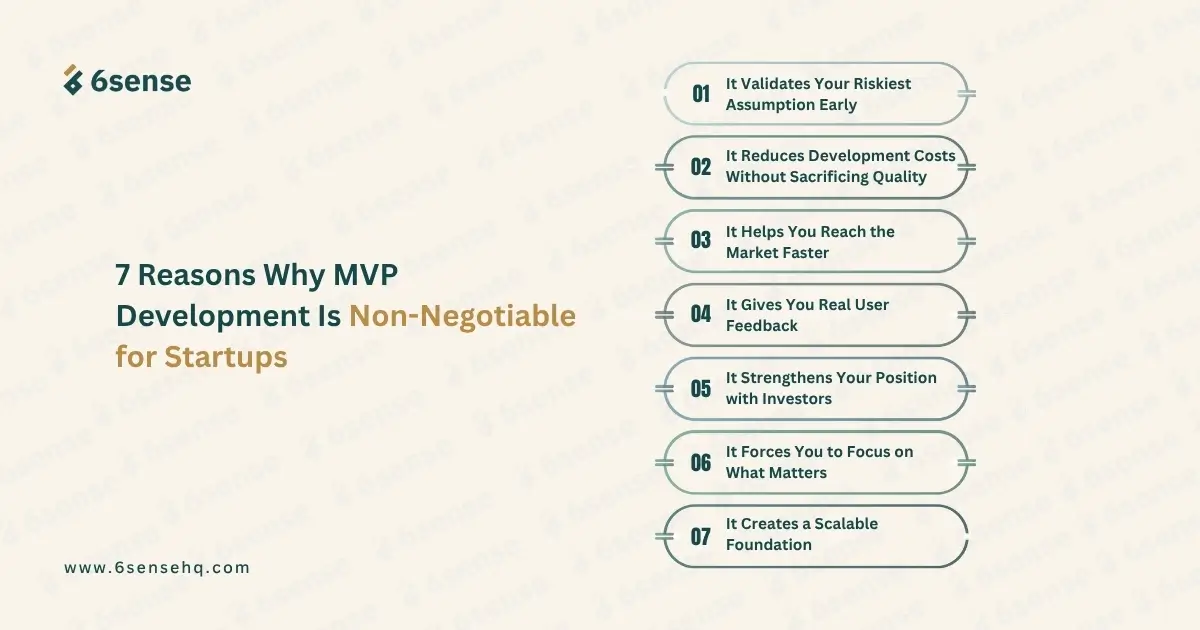
The core goal of a minimum viable product is simple. It helps you answer one question before anything else: should this product even exist?
According to CB insights around 43% of startups fail because there is no market need for the product. Instead of guessing, you use real users to validate your idea. Every week you skip this step, you’re betting your startup on assumptions rather than evidence.
By focusing only on essential features, MVP development avoids unnecessary software development work. You spend less time building features that may never be used.
Full-scale builds without validation don’t reduce risk. They increase development costs and make mistakes more expensive.
Speed matters in any startup. MVP development allows you to launch faster, test quicker, and improve through iteration.
While others are still planning, you’re already learning from real users.
Internal ideas are assumptions. Real users give you clarity. An MVP allows you to collect feedback early and shape your product development based on actual behavior.
Without this, you’re building based on opinion, not data.
Investors look for proof, not just ideas. A working MVP with real traction shows that your startup has potential.
It demonstrates that you’ve already taken steps to validate demand, which builds confidence during fundraising.
MVP development pushes your team to prioritize. You focus only on what feature is essential to test your idea.
This discipline helps avoid feature bloat and keeps your product development aligned with real goals.
A well-built MVP is not wasted effort. It becomes the base for future growth and full-scale product development.
It is easy to discuss the practical advantages of developing an MVP, but the strongest evidence comes from companies that used this approach to validate their ideas before scaling. Many successful startups did not begin with full product development. They started small, tested demand, and improved their products through continuous iteration.
Before building a full platform, Airbnb’s founders simply rented out their own apartment using a basic webpage. This early version of a minimum viable product helped them validate whether people were willing to pay to stay in someone else’s home.
They didn’t build complex systems first. They tested demand first.
Dropbox avoided heavy software development in the beginning. Instead of building the full product, they created a short explainer video showing how it would work.
The response was immediate. Thousands of users signed up, proving real interest before investing in development. This reduced risk and guided future product development.
Zappos started with a simple idea. The founder listed shoes online without holding inventory. When someone placed an order, he bought the shoes from a local store and shipped them.
This approach helped validate demand without building a full system or incurring upfront inventory costs.
None of these companies built everything first. They focused on the smallest possible version that could test real demand.
42% of startups fail because there is no real market need. MVP development is the one process designed to prevent exactly that outcome.
Even when founders understand why MVP development matters, execution mistakes can still put a startup at risk. The goal is not just to build an MVP, but to build one that actually helps you validate your idea.
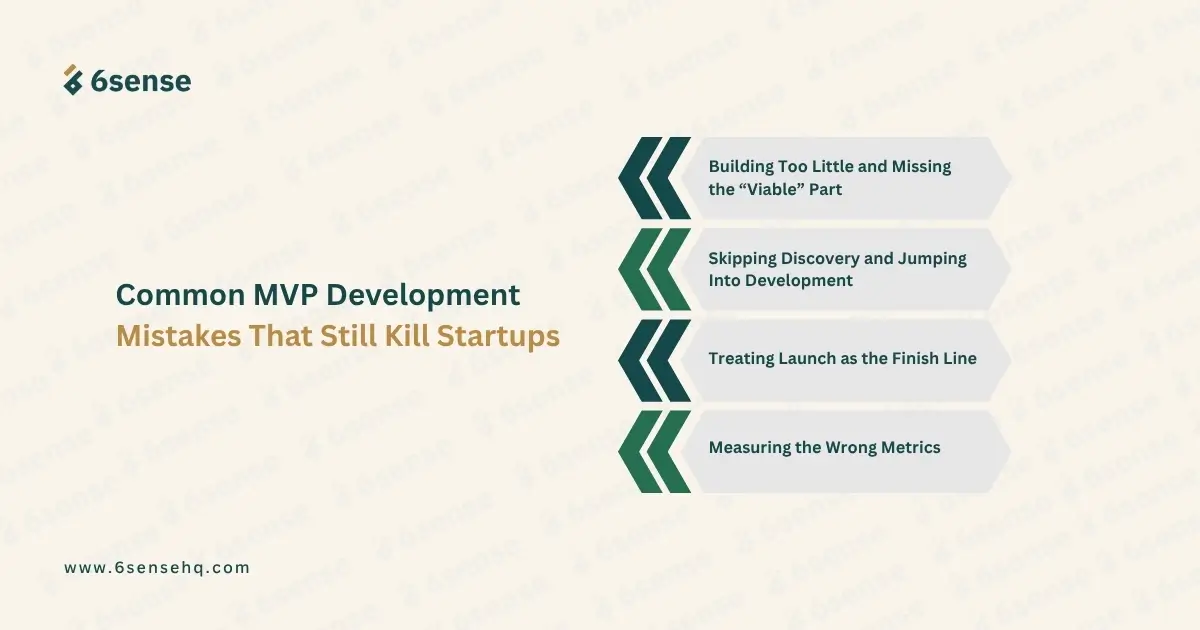
The common challenges teams face when developing an MVP often include unclear scope, poor user research, weak feature prioritization, misleading success metrics, and a lack of planning for post-launch iteration. Addressing these issues early helps founders preserve their budget and collect more reliable validation data.
Some teams focus too much on keeping things minimal and forget about usability. If your minimum viable product cannot deliver real value, users will not engage with it.
An MVP that no one can use gives you no meaningful feedback.
The Fix
Define one core problem your product solves and make sure users can complete that flow end to end. Your MVP should be simple, but still usable and valuable.
One of the biggest mistakes in product development is rushing into software development without understanding users.
Without proper discovery, you are still making assumptions instead of testing them. This leads to building the wrong features and missing the chance to validate early.
The Fix
Talk to real users before building. Map their workflow and identify what they are already using. Validate the problem before writing any code.
Launching an MVP is not the end. It is the start of the learning phase. Many founders launch and move on instead of improving the product through iteration.
The real value of MVP development comes after launch, when you refine the product based on user behavior.
The Fix
Track how users interact with your product from day one. Use that data to guide updates and improve the product in small, consistent iterations.
Tracking downloads or sign-ups alone does not tell you if your product works. What matters is how users behave.
Focus on metrics like retention, engagement, and repeat usage. These signals show whether your startup is moving toward a product users actually need.
The Fix
Define one or two key metrics that reflect real usage. Focus on retention and repeat actions instead of vanity metrics like traffic or installs.
If you are building a startup, every month spent on product development without validation increases your risk. It is not just time you lose. It is budget, momentum, and the opportunity to validate your idea before it is too late.
A minimum viable product helps you test assumptions early, learn from real users, and improve through iteration. It turns uncertainty into data and gives your product a real chance to succeed.
At this point, the question is no longer whether you should build an MVP. Why haven't you started yet?
If you are ready to move forward, working with the right team offering MVP development services can help your startup build an MVP faster, smarter, and with far less risk.
So, if you want to work with an MVP development partner then reach out to us. Lets have a discovery call to find the best possible outcome for your MVP.
Compare 6sense HQ and DevToDollars on MVP speed, team models, proof, pricing, and post-launch support to pick the right fit.
15 min read

Compare 6sense HQ alternatives for MVP development in 2026 and find the best software team for your startup budget and goals.
17 min read

Learn whether one developer can build an MVP in 2026 with cost, scope, AI tools, low-code tips, risks, and launch advice.
22 min read