


6sense HQ vs DevToDollars: Best MVP Partner in 2026
Compare 6sense HQ and DevToDollars on MVP speed, team models, proof, pricing, and post-launch support to pick the right fit.
15 min read
Tech startup MVP guide: when to build, 7 steps to launch fast, and top mistakes to avoid while validating demand.
Written by: AKM Ahsan Created on: 3 Mar 202620 min to read
Every tech startup begins with an idea. But ideas don’t fail because they’re bad. They fail because they’re built the wrong way, too big, too expensive, too late to validate.
That’s where MVP development for startups becomes critical. Whether you’re a technical founder who can code or a non-tech founder with a strong vision, building an MVP helps you test assumptions, validate demand, and move forward with confidence, without burning months of time and money.
In this guide, we’ll break down how MVP development works for tech startups, when to build one, where to begin, and what mistakes to avoid.
An MVP (Minimum Viable Product) is the simplest version of your product that solves one clear problem for one clear group of users.
It is not:
It is:
For tech founders, MVP development prevents overengineering. Instead of building every feature you imagine, you build what users actually need.
For a non-tech startup founder, an MVP helps you:
Real Success Example: With support from 6sense HQ, a solo startup founder of Impromek turned weeks of struggle into a fully functional MVP with separate admin, teacher, and student panels, plus Stripe payments integrated to cut transaction fees and simplify operations. This working product enabled real user engagement and helped the founder pivot from stalled development to scaling with confidence.
Startups should build a Minimum Viable Product because it turns an idea into a real test. Before spending months on a full product, founders can launch a smaller version, show it to early users, and see if the problem is truly worth solving. This matters because people often say they like an idea, but their real behavior tells a clearer story. Reddit founders often point out the same thing: an MVP should prove the core value first, not impress everyone with extra features.
A good MVP helps you learn what users need, what they ignore, and what should be improved next. It keeps cost low, reduces risk, and gives your startup a smarter path before scaling with more confidence later.
Many founders hear “minimum” and forget “viable.” But an MVP is not the weakest version of your product. It still needs to solve one real problem properly. Reddit founders often warn that users will not give useful feedback if the product is too broken or unclear. They may simply leave. The goal is to remove extra features, not remove basic value.
A viable MVP should let users complete the main task without confusion. It can be simple, but it must be usable, reliable, and clear enough to test whether people actually want the solution in a real market setting first.
A good MVP is like a cupcake, not a half-made wedding cake. If your final product is the wedding cake, the MVP should be a small but complete version that gives users the real taste of the value. A cupcake has the basic parts: cake, filling, and frosting. It is smaller, cheaper, and faster to make, but it is still enjoyable.
In the same way, your MVP should not be just a login screen, dashboard design, or broken feature. It should deliver one complete user experience, so you can learn what users like, dislike, and need next with confidence early.
An MVP is not a cheap shortcut, a buggy demo, or a smaller copy of your full product. It is also not a place to dump every feature you hope to build later. A weak MVP confuses users because it tries to do too much or fails to do one thing well. A proper MVP has a clear purpose: test one important assumption with real users. It should be simple enough to launch quickly, but strong enough to teach you something useful. If users cannot understand the value, complete the main action, or give feedback, it is not an MVP.
Atlassian defines an MVP as the simplest product version used to validate ideas and gather feedback, while Reddit startup discussions warn against treating MVP as half-baked or unclear. The cupcake analogy also comes from MVP/cake model discussions, where the main idea is that the first version should be small but still complete enough to show real value.
Not all MVPs look the same; different types help you test different assumptions about your idea. The type you choose depends on what you want to learn first and how you plan your agile development approach during the mvp development process to validate product ideas before fully building them to market.
Here are the most common types:
A basic web page that explains your idea and collects email interest. It tests interest in your feature mvp before you build anything, letting you see if people care about your idea early in the market before investing in full development.
In a concierge mvp, you manually serve your first users behind the scenes. This hands‑on approach lets you interact with users directly and understand their needs before you build automation, saving time and resources while you refine your feature mvp.
The app or interface looks real, but the backend is manual. Users think the product is automated even though people are delivering value behind the scenes. This lets you validate core workflows without full development and see if the product concept resonates in the market.
You show a feature or offer a minimum product before building it to see how many people actually want it. This kind of test gives you insight into whether your idea has real market demand before heavy investment in code or other software development.
A very basic version of your product with the core features only, so real users can use it and you can collect feedback. This traditional MVP style helps you see how users interact with essential elements and avoid building extra parts that aren’t needed in the full launch.
A piecemeal mvp combines existing tools and services to form a working experience without building everything from scratch. This can speed up time to market and reduce risk, especially when you want to test complex concepts without a full stack of custom backend code.
Some startups work with an MVP development company to choose the right MVP type and guide them through agile development and complex software development decisions. These teams help structure validation and scale the MVP into a full product more efficiently.
An MVP helps startups save money by building only what’s essential at first. Instead of spending thousands on a full product that might fail, you focus on core features that prove value. This reduces upfront costs, avoids waste, and stretches limited resources until you know what customers really want.
By launching a simplified version quickly, you get into the market faster than competitors. This gives you a head start in collecting real user data, refining your idea, and gaining early adopters. A faster entry also helps you learn sooner if your concept is viable, letting you adapt before others do.
An MVP lets you test your idea with real users, not just guesses. Early adopters interact with your product and give honest opinions on what works and what doesn’t. Their feedback shows you whether you’re solving a real problem and guides the next improvements, saving time and effort later.
Instead of risking large investments in a product that might not sell, MVPs let you test critical assumptions first. You uncover issues early, pivot if needed, and fix key problems while costs are still low. This approach reduces the chances of major failures later in development.
An MVP is designed to grow over time. Once the basic version is launched and users start interacting, you can make improvements step by step. These iterations are based on real data and user behavior, not guesswork, which helps build a stronger final product.
With an MVP, you can experiment with pricing and value delivery before fully investing. By trying different models like subscription, freemium, or pay‑per‑feature on a small scale, you discover what customers are willing to pay for and build a revenue plan that actually works.
Investors love proof. A working MVP with real users and early traction shows that your idea has potential and isn’t just a concept. Demonstrating initial demand and learning from feedback makes it easier to convince stakeholders and secure funding.
User research means talking to real people who might use your product so you can understand their problems, goals, and behavior. This helps you build only what truly matters instead of guessing. Surveys, interviews, and observing how users behave give you clear data for smarter decisions and reduce the risk of building the wrong product.
Competitive analysis is studying similar products already in the market — what they do well and where they fall short. This helps you find a gap you can fill, avoid mistakes others made, and position your MVP more effectively. Looking at pricing, features, reviews, and user feedback reveals how you can make your version stronger.
Adaptability means your MVP should be flexible — able to change based on what users tell you. A fixed design makes pivoting hard if feedback shows something isn’t working. Being adaptable lets you test ideas quickly, adjust features, and make improvements without rebuilding the product from scratch.
Runway refers to the amount of time and money your startup has before you run out of resources. A good MVP preserves runway by focusing on essential features instead of building everything at once. When you spend wisely and test early, you extend your runway, giving more time to learn and grow.
An MVP helps you check if your idea really works before building the full product. By releasing a basic version to real users, you can see if people actually want and use it. This reduces the chance of spending too much on something that might fail, and guides you to improve what matters most.
Using an MVP means you build, learn, and improve in steps instead of all at once. Startups collect feedback, fix issues, and add features bit by bit based on real user reactions. This cycle saves time and helps create a product that actually fits what users want, rather than guessing.
One of the biggest benefits of an MVP is getting real opinions from real users. Early users show you what works, what doesn’t, and what they really need. This feedback helps you make smarter decisions about features and improvements so your final product is strong and aligned with customers’ expectations.
An MVP lets you launch fast instead of waiting to build a full product. Getting to the market early helps you start earning users, learn quickly, and stay ahead of competitors. Being first gives you a chance to build loyal users before others copy a similar idea.
Once your MVP proves that people want your product, your startup can focus resources on scaling, adding features, improving performance, and expanding your audience. Because the core idea is already tested, scaling becomes less risky and more strategic, helping you grow faster and smarter.
Building an MVP means spending only on the most important parts of your product first. This keeps your costs lower and your investment manageable, especially when resources are tight. You can save money and time, then invest more only after you see what works and what users really value.
An MVP (Minimum Viable Product) isn’t just a small version of your idea, it’s a real test in the real world. Instead of guessing whether people will like your product, an MVP helps you learn from actual users before you build everything. You create just enough features to provide value and then watch how real people interact with it. This reduces risk, saves time, and stops you from building features no one wants. Founders who need a more structured path can follow this step-by-step guide to building an MVP for an early-stage startup, covering the journey from initial validation and feature selection to launch, measurement, and iteration.
Here’s how an MVP works in simple terms:
This first validation step can turn something that might be good into something the market truly wants.
In early stage startup mvp development, timing always matters Knowing when to start mvp development, and how that fits into your overall product development and agile development approach, can make the difference between a prototype that succeeds and one that fails without real user feedback. An MVP is not just a draft, it’s a viable product designed to test real demand and guide your next steps.
You should start mvp development for tech startups when:
These stages give you the clarity and confidence to begin building a viable product version that helps you learn before scaling.
You should not build an MVP when:
As Reid Hoffman, co-founder of LinkedIn, says:
This means it’s better to start mvp development earlier and refine your approach based on real user feedback, rather than waiting too long and losing valuable learning time.
So, think of it like this:
Idea → Research → Clear Problem → MVP Development → User Feedback → Iteration → Growth
A Proof‑of‑Concept (POC) is a small test you run before an MVP to check that your idea can technically work. It doesn’t have full features, and it isn’t meant for real users, it’s just an internal test. For example, if your product idea depends on a new AI technology, a POC might test whether the AI can solve the core part of your idea.
Think of POC as checking feasibility and MVP as checking market demand.
MVP timelines depend on what you are building. For a simple web or mobile MVP, 6sense HQ says development usually takes around 6–8 weeks when the scope is clear. A full web app can take 6-12 weeks, while larger platforms with many roles, dashboards, integrations, payments, or custom workflows can take 12+ weeks or move toward an 8-16 week range.
If the product is still unclear, the first step is not coding. Founders should define the core features, user flow, budget, and roadmap first. 6sense HQ also mentions that clients can get a clear scope and timeline within 48 hours after the discovery call, which helps avoid guessing before development starts.
Sources: 6sense HQ says MVPs usually take 8-16 weeks on its MVP agency page, while its web and mobile app pages mention 6-8 weeks for MVPs, 6-12 weeks for apps, 12+ weeks for larger platforms, and timeline clarity within 48 hours.
Lean startup MVP process starts long before you write code; it begins by understanding your idea, your users, and real evidence that people want what you’re building.
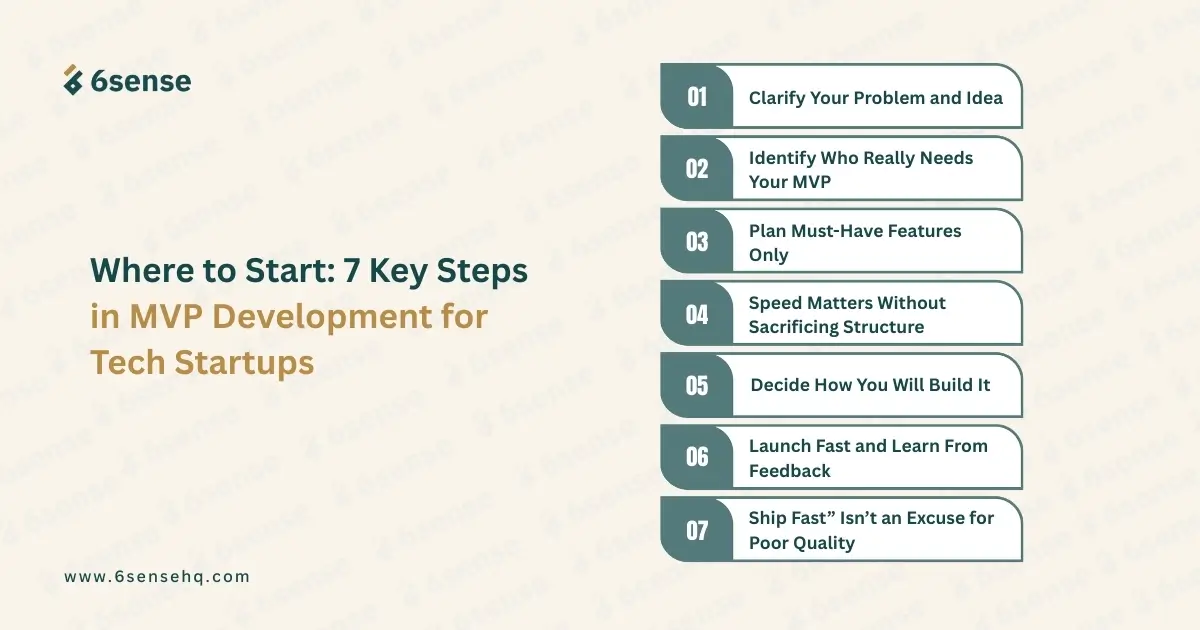
Start by writing down your idea in simple words, so you truly understand the core problem you want to solve. Speak to potential users and confirm they see that problem the same way you do.
This step matters because many startups fail before they even reach product-market fit. According to a CB Insights report, 42% of startups fail because they build products that don’t solve a real market need.
That’s why validating the problem early, before writing code, is a core principle of the MVP approach.
Figure out who is most likely to use, or even pay for, your MVP. Reddit discussions stress focusing on a specific group instead of saying “this is for everyone.” Listen to potential customers and learn where they hang out, what words they use, and what matters most to them.
List all possible features, then cut them down to only what actually proves your idea. The goal is not to impress people with bells and whistles; it’s to solve the main pain and gather real feedback. Keep your MVP narrow, easy to understand, and quick to release.
For SaaS-based startups, mvp development for saas involves understanding the unique needs of software users. This focus is important because many products fail when teams build too much before validating the core need. Research shows that around 80% of new products fail to meet their objectives after launch, often because companies invest heavily in features without confirming real demand first.
Building an MVP quickly doesn’t mean writing messy code that breaks under pressure. The goal is to deliver core value fast while designing a system that can be extended cleanly later.
A balanced MVP architecture keeps the codebase modular, maintainable, and easy to iteratively improve, for example, using simple layers or basic abstractions so future refactors are easier without delaying launch.
Even if you can build your MVP yourself, it’s worth weighing whether outside help makes sense. Outsourcing can speed up delivery, give you access to experienced developers, and let you focus on growth and customer validation instead of writing every line of code.
“The value of an MVP is not in perfect code, but in learning what users truly want, fast,” say many tech founders, emphasizing that MVPs are about testing real behavior, not building flawless products before validation.
Get a simple version out to a small group of real users as soon as possible and observe what they do, not just what they say. Successful MVP builders stress that real behaviors matter.
Track actions, ask for honest feedback, have good MVP development partner and prepare to adapt quickly based on what you learn.
Shipping fast is essential to learning, but “fix later” shouldn’t mean delivering a buggy, unusable product. A successful MVP must be usable and learnable from — not so rough that users abandon it.
Prioritize reliability and basic UX first, then iterate based on real user data.
By 2026, most MVPs will include some form of AI right from the start. Instead of AI being a bonus feature, users now expect smart suggestions, automation, or predictions built into the core product. This trend helps founders test if intelligent features truly improve user experience and solve real problems faster than manual solutions.
No‑code and low‑code platforms like Bubble, Webflow, and Retool are becoming capable of handling real, production‑level apps, not just prototypes. This means non‑technical founders can build and test working MVPs fast without writing much code. These tools help startups save time and money while validating ideas quickly.
Instead of building products for everyone, startups are focusing on very specific user groups or niche needs. Hyper‑personalization means tailoring features or content to each user, which boosts engagement and helps find product–market fit faster. Targeting a clear niche also makes feedback more useful for guiding the next steps.
Startups are now using synthetic data — fake but realistic datasets — to test and train features without risking real user information. This helps especially in regulated industries like health and finance, where using real data can be risky or illegal. Synthetic data speeds up testing and preserves privacy.
Rather than planning long lists of features, modern MVP teams build roadmaps around experiments: ship a hypothesis, measure results, and then decide what’s next. AI tools play a big role in tracking user behavior, running A/B tests, and suggesting improvements, which speeds learning and reduces guesswork.
Users and regulators care more about data privacy and ethical use of technology than ever. Startups are building MVPs with security and compliance as core principles, not afterthoughts. This means encrypting data, obtaining clear user consent, and avoiding biased AI practices from day one to gain trust and avoid legal issues.
Instead of building tightly connected codebases, startups are using modular systems and APIs (interfaces between parts of software). This makes MVPs more flexible, easier to update, and simpler to scale later. If any part needs improvement, it can be swapped out without breaking the whole product.
Modern MVPs rely on deep analytics and event tracking from day one. Tools like Mixpanel or Amplitude help teams see exactly how users interact with each feature. This data drives smarter decisions, shows where users struggle, and highlights what’s most valuable — which is why analytics is no longer optional.
Startups are experimenting with pricing that ties cost to real results rather than flat subscription fees. For example, people may pay only when they see value or hit specific milestones. This builds trust, encourages adoption, and aligns pricing with user success, helping MVPs gain early traction in competitive markets.
As MVP expectations rise, many startups are choosing to work with specialized MVP studios or teams that understand modern product building. These partners provide structure, experience, and strategic guidance, not just one‑off freelance help. This often leads to faster growth and higher quality validation.
MVP development is a learning tool, not a race to finish a product. Many startups make predictable mistakes that waste time, money, and traction. Avoiding them early helps you focus on real value, user feedback, and validated learning.
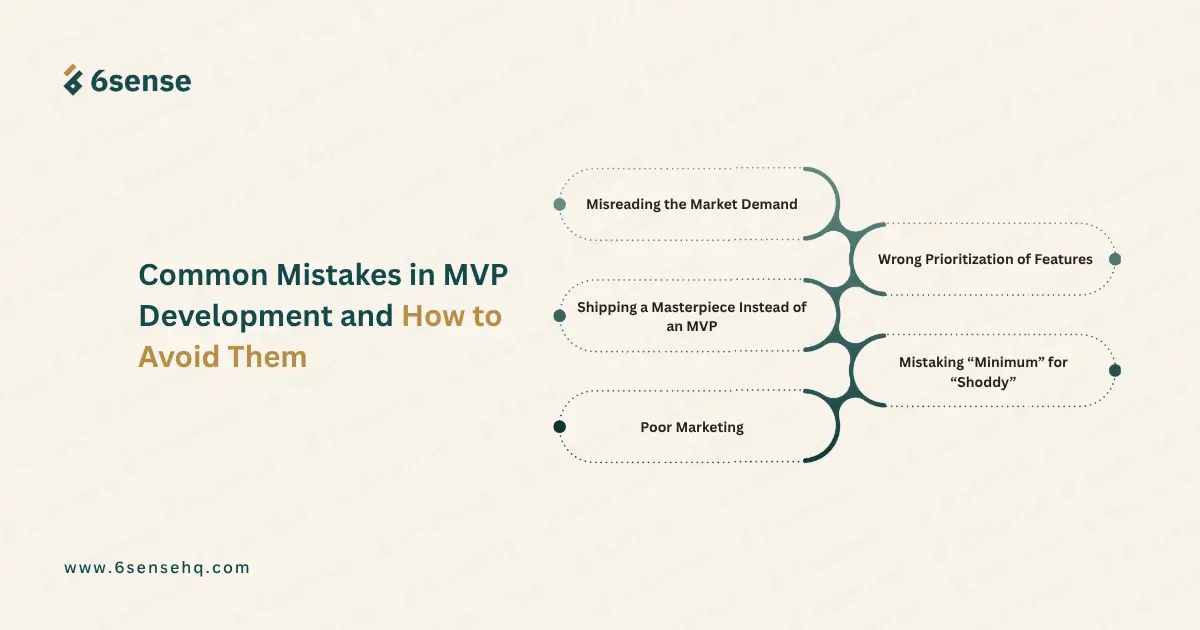
Building the wrong product because you didn’t ask actual users first.
Solution: Do market research and user interviews before you build.
Adding too many features or the wrong ones.
Solution: Only include what directly solves the core user problem — no extras.
Trying to make it perfect before launch.
Solution: Release early and improve based on feedback — MVPs are about learning, not perfection.
Thinking MVP means cheap or low quality.
Solution: Keep quality where it matters — usability and value first.
Assuming users will find your MVP without promoting it.
Solution: Plan how users will discover your product, as it matters as much as the product itself.
Many early-stage founders struggle to turn an idea into a working product. In several cases, working with the right development partner helped founders move from concept to launch much faster.
One client shared their experience after partnering with 6sense HQ:
“Their strong technical skills and speed of development are super impressive. The Agile process, clear communication, and flexibility made them a dependable partner for delivering features on time.”- Gabriel Sotomayor, Founder of Impromek.
For the Impromek platform, 6sense HQ helped a solo founder move from an unfinished idea to a fully functional MVP with admin, teacher, and student panels and Stripe payment integration, allowing real users to start using the product and enabling the founder to focus on growth instead of technical issues.
MVP development isn’t about just building something quickly; it’s about launching a lean product that teaches you what users truly need while minimizing risk and cost.
By focusing on essential features and learning from real users, you increase your chances of finding product–market fit and building something the market actually wants. Startups that embrace this approach build smarter, not harder, and stay flexible as they grow.
Remember, the goal is insight first, perfection later. Book a call with 6sense HQ to get a tailored MVP roadmap to kickstart your startup today!
Compare 6sense HQ and DevToDollars on MVP speed, team models, proof, pricing, and post-launch support to pick the right fit.
15 min read

Compare 6sense HQ alternatives for MVP development in 2026 and find the best software team for your startup budget and goals.
17 min read

Learn whether one developer can build an MVP in 2026 with cost, scope, AI tools, low-code tips, risks, and launch advice.
22 min read