


Best SaaS Development Methodologies for Startups 2026
Choosing the right SaaS development methodology is key to growth. Learn how Agile, Lean, and DevOps can help scale your startup.
6 min read
Master the SaaS development process with our step-by-step guide on planning, building, and scaling a successful cloud product.
Written by: AKM Ahsan Created on: 17 Apr 20268 min to read

Building a SaaS product sounds exciting until you realize most ideas fail before they even launch. Not because the idea was bad, but because the process behind building it was messy or incomplete.
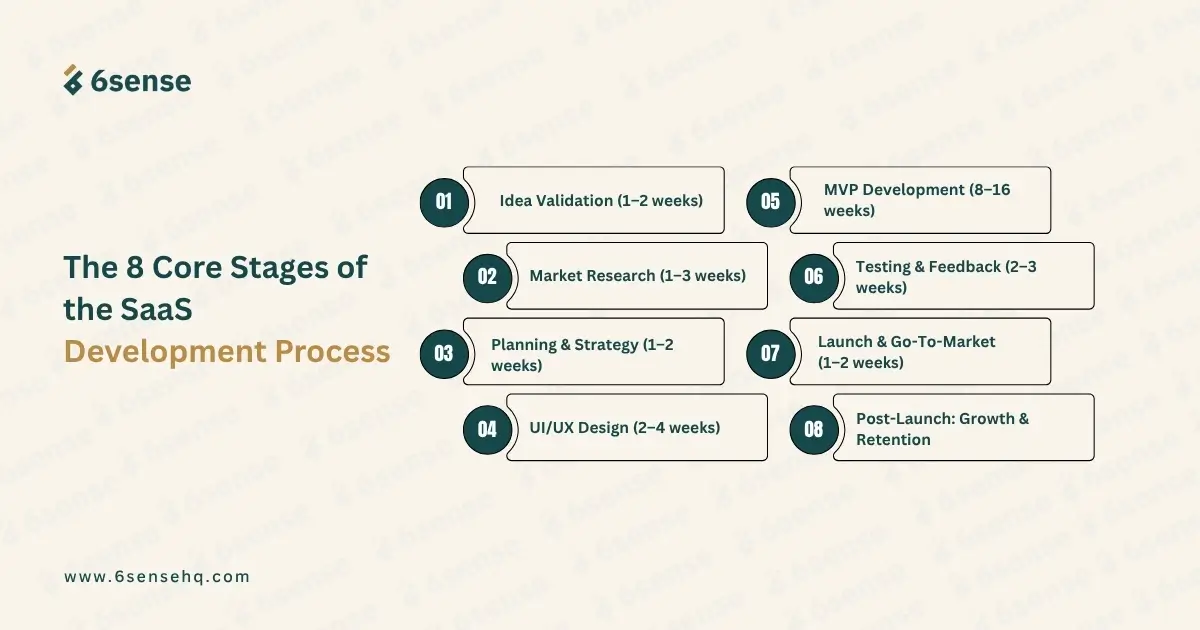
The SaaS development process is a structured lifecycle used to build cloud-based software products through defined stages: (1) Idea Validation, (2) Market Research, (3) Planning & Strategy, (4) UI/UX Design, (5) MVP Development, (6) Testing & Feedback, (7) Launch, and (8) Post-Launch Growth. Each stage reduces risk and ensures the product solves a real user problem before scaling. In this blog, you will learn what SaaS development really means, how to plan, build, and scale your product step by step in a simple way.
The SaaS development process is the step-by-step way of building software that people can use online without installing anything. Unlike traditional software, SaaS is not a one-time build. It is a continuous system that evolves through feedback, iteration, and scaling over time.
Many founders online say the biggest mistake is jumping straight into coding. One developer shared, “Most people build first and think later, and that’s why products fail.”
Instead, successful SaaS products follow a structured path. This helps teams avoid confusion and build something users actually need.
Also, the SaaS market is expected to reach $307.3 billion by 2026, showing how fast this space is growing.
In simple words, it is the roadmap that turns an idea into a working product.
Before jumping into software development, it’s important to understand the benefits of SaaS development today. Many founders and teams share real lessons about growth, mistakes, and what actually works in building software products.
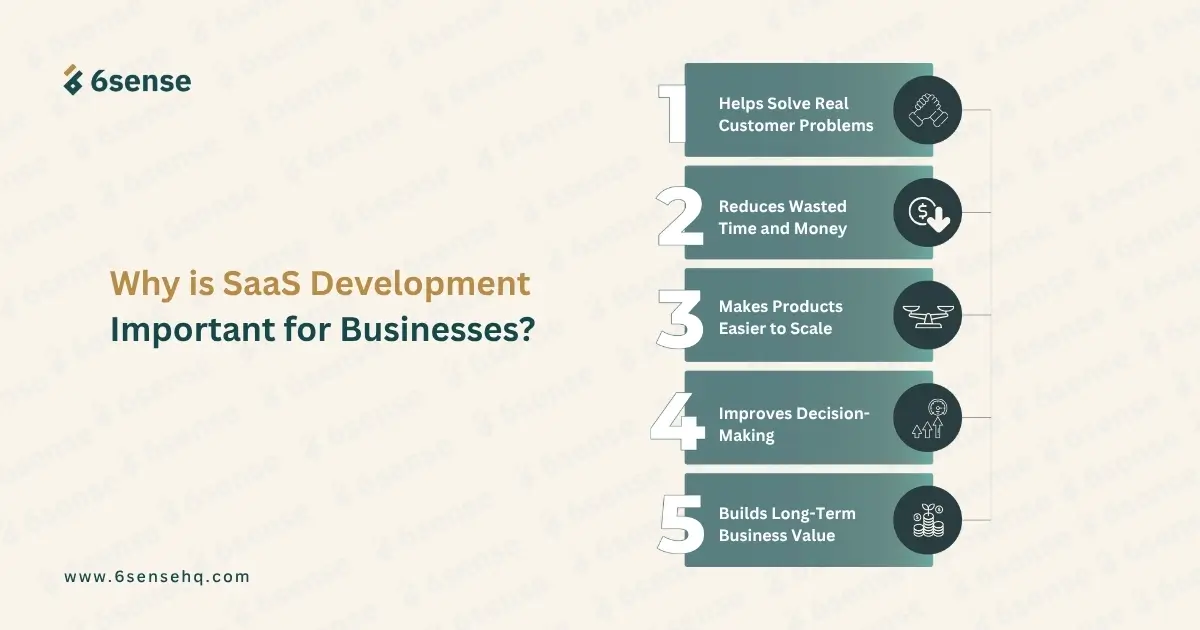
SaaS products work best when they solve clear problems. Many founders realize that if their product is not in the “top 3 problems” for users, it simply won’t succeed. That’s why development must always start with understanding real pain points.
Many early builders admit they wasted months building features no one used. A proper SaaS process and frameworks help avoid this by testing ideas early, before investing heavily in development.
SaaS is built for growth. Once the product works, you can serve thousands of users without major changes. This makes it one of the most scalable business models today.
When you follow a process, you make better decisions. You validate ideas, test features, and adjust based on feedback instead of guessing what users want.
SaaS products are not one-time sales. They generate recurring revenue, which makes businesses more stable and valuable over time.
Planning is where most SaaS products either quietly succeed or fail long before launch.The strongest SaaS teams treat planning as a validation engine, not a documentation task.
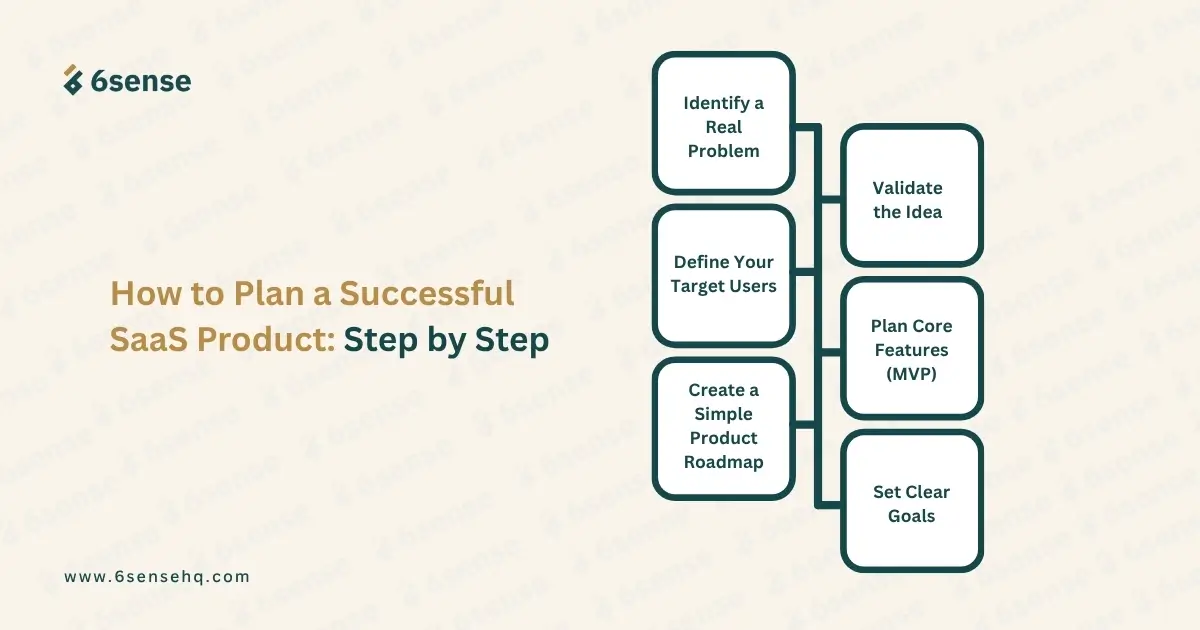
The biggest mistake founders make is building for assumptions instead of real user “jobs.”
A powerful way to avoid this is using the Jobs-to-be-Done (JTBD) framework. Instead of asking “What features should we build?”, you ask:
JTBD focuses on the idea that users don’t buy products—they “hire” them to solve a problem.
This is where customer interviews become critical. A simple 10–15 conversation loop can uncover:
If users are already solving the problem manually, that’s your strongest validation signal.
Once the problem is clear, the next challenge is deciding what NOT to build.
This is where most SaaS products lose focus.
Two proven frameworks help here:
MoSCoW Framework
This method forces teams to protect MVP simplicity and avoid feature creep.
RICE Framework
RICE adds a quantitative layer, helping teams rank features objectively instead of relying on opinions.
In practice:
Together, they ensure you ship the smallest product that still delivers real value.
A roadmap is not a feature list, it’s a decision-making tool.
A simple SaaS roadmap should include:
Good roadmaps are tied to outcomes, not ideas. Without structure, decisions default to “who speaks the loudest” instead of what creates value.
A useful addition here is defining a North Star Metric, a single number that reflects real user value (e.g., “tasks completed per team per week”).
Many teams confuse activity with progress. That’s where goal systems matter.
KPIs (Key Performance Indicators)
OKRs (Objectives and Key Results)
OKRs bring alignment and focus by tying goals to measurable outcomes.
In SaaS:
Let’s bring this into a real-world scenario.
A 6sense HQ client came in with an idea: “Build a platform for operations teams to track internal workflows.”
Step 1: Problem Validation Instead of jumping into development, the team conducted interviews. Insight: Teams weren’t lacking tools, they were overwhelmed by fragmented tracking (Slack, Excel, emails).
JTBD became:
“When managing multiple tasks across teams, I want a single view of progress so I can avoid manual follow-ups.”
Step 2: MVP Scoping Using MoSCoW:
Using RICE:
Step 3: Roadmap
Step 4: Goals
Outcome: The MVP launched faster, adoption was immediate, and the product evolved based on real usage, not assumptions.
This is where everything starts. You test if your idea solves a real problem.
What happens:
Common mistake: Building before validation
Understand competitors and gaps.
Tools used:
This is where most SaaS products succeed or fail.
Key frameworks added:
What you define:
Design how your product will look and feel.
Tools:
Output: clickable prototype
This is where coding begins.
Typical timeline:
Recommended Tech Stack by Stage:
| Component | Early Stage | Scale Stage |
| Frontend | React | Next.js |
| Backend | Node.js | Python / Go |
| Database | PostgreSQL | Distributed DB |
| Cloud | AWS | AWS/GCP |
| Payments | Stripe | Stripe |
| CI/CD | GitHub Actions | Kubernetes |
Use Agile methodology with sprint planning and CI/CD pipelines to continuously release features and gather feedback.
Test your product with real users.
Types:
Output: bug-free MVP
Launch your product publicly.
NEW ADDITION:
This is where most SaaS businesses actually win or fail.
After launch, focus on:
Key actions:
| Stage | Duration | Output |
| Idea Validation | 1–2 weeks | Validated idea |
| Market Research | 1–3 weeks | Market insights |
| Planning | 1–2 weeks | MVP roadmap |
| UI/UX Design | 2–4 weeks | Prototype |
| Development | 8–16 weeks | MVP |
| Testing | 2–3 weeks | Stable product |
| Launch | 1–2 weeks | Live product |
| Post-Launch | Ongoing | Growth |
Built to solve fragmented workflow tracking for operations teams. We chose a modular architecture using Node.js + AWS to ensure scalability.
Challenge: Handling real-time updates across teams
Outcome: Reduced manual tracking time by 40%
Focused on data-driven decision dashboards.
Challenge: Designing an intuitive UI for complex data
Outcome: Improved user engagement by 2x
Building a SaaS product is not about coding fast; it is about following the right process. From idea validation to continuous improvement, every step plays a key role in success. Many failures happen because teams skip planning or ignore user feedback.
If you keep things simple, focus on real problems, and improve consistently, your chances of success increase a lot. Take time to understand your users, test your ideas, and grow step by step. That is how successful SaaS products are built today.
We’ve helped 50+ founders move from idea to live SaaS products using this exact process. If you’re building something right now, here’s what a focused conversation with the 6sense HQ team looks like.
Choosing the right SaaS development methodology is key to growth. Learn how Agile, Lean, and DevOps can help scale your startup.
6 min read

Learn why SaaS development is faster and more scalable than traditional software. Compare deployment, cost, and cloud agility.
9 min read

Master the SaaS development process in 2026. Learn about costs, tech stacks, and best practices to build and scale your cloud software.
11 min read