


Best SaaS Development Methodologies for Startups 2026
Choosing the right SaaS development methodology is key to growth. Learn how Agile, Lean, and DevOps can help scale your startup.
6 min read
Learn why SaaS development is faster and more scalable than traditional software. Compare deployment, cost, and cloud agility.
Written by: AKM Ahsan Created on: 16 Apr 20269 min to read

Most software today doesn’t come in a box anymore. You don’t install it once and forget it. You log in, and it just works. That shift is exactly why SaaS has become so popular.
At 6sense HQ, we have helped 50+ businesses build both SaaS products and traditional software systems across industries like fintech, healthtech, and B2B. The differences we explain here come from real-world build decisions, not theory.
SaaS development is different from traditional development in four key ways: deployment (cloud vs local), updates (automatic vs manual), scalability (elastic vs hardware-based), and cost (subscription vs one-time license).
In this blog, we’ll break down how SaaS development is different from traditional development, how deployment, scaling, and maintenance change, and what that means for businesses and developers.
SaaS development is built for speed, scale, and continuous improvement, while traditional development focuses more on control and customization.
SaaS development frameworks, often based on agile methodologies, enable teams to build cloud-based applications that users can access online without installation. Teams release features frequently using CI/CD pipelines and DevOps practices, sometimes weekly, to keep improving the product. This fast cycle is often supported by agile development and constant testing.
Traditional software, on the other hand, is usually installed locally. It requires manual setup, updates, and maintenance. It gives full control, but it’s slower to change and harder to scale.
As Werner Vogels puts it:
“You build it, you run it,” is a principle that reflects how modern cloud systems empower teams to continuously deploy, operate, and improve software without traditional handoffs.
Also, according to Forrester, SaaS deployment can be up to 5x faster than traditional software setups.
From real developer discussions, one big difference stands out: SaaS is built to grow fast and adapt quickly, while traditional software is built to be stable and controlled.
Here’s a quick side-by-side difference between saas and traditional to make things easier to understand before diving deeper into the development differences below.
| Aspect | SaaS Development | Traditional Development |
| Deployment | Cloud-based, instant | Local installation |
| Updates | Automatic (CI/CD) | Manual updates |
| Scalability | Elastic (cloud scaling) | Hardware dependent |
| Cost Model | Subscription | One-time license |
| Maintenance | Provider-managed | Internal IT |
| Accessibility | Anywhere | Device-limited |
| Security & Compliance | SOC2, ISO, GDPR-ready | Fully controlled internally |
| Customization Depth | Limited, config/API-based | Fully customizable |
| Time to Market | Fast (days/weeks) | Slow (months) |
| Vendor Lock-in | Possible risk | Full ownership |
SaaS completely changes how software is deployed and managed compared to traditional systems. Let’s break down the real differences developers and teams experience.
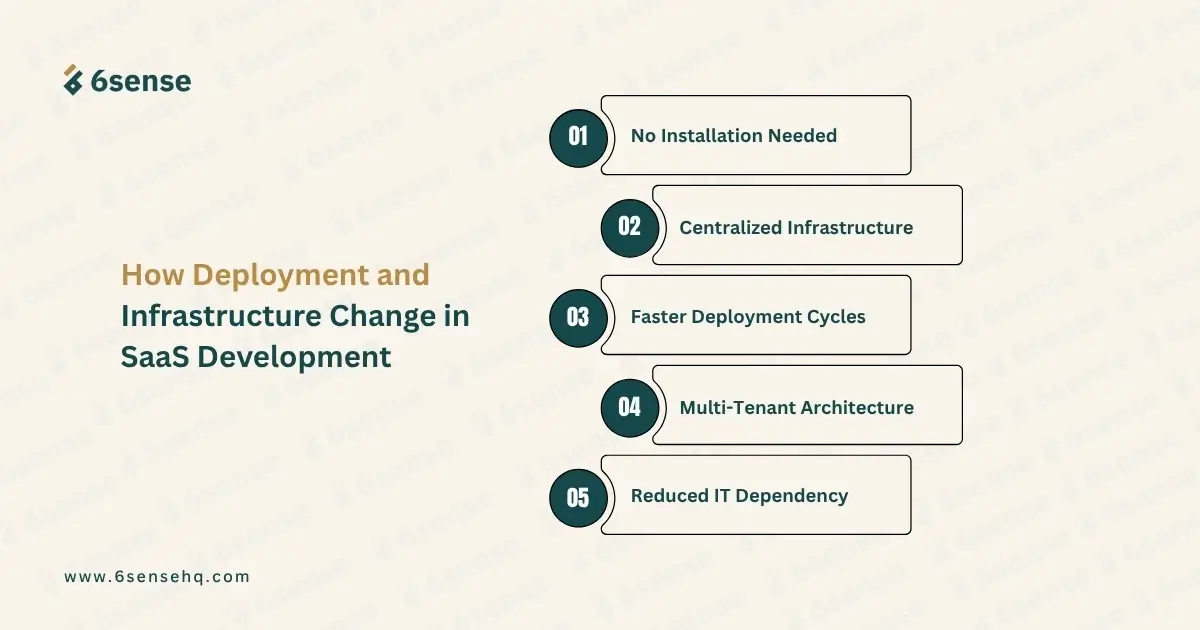
Cloud adoption data shows that 94% of enterprises already use cloud services, highlighting how SaaS-style deployment has become the dominant model.
In SaaS, users don’t install anything. Developers deploy apps to the cloud, and users access them instantly. Traditional software requires manual setup, which slows adoption.
SaaS runs on centralized cloud servers using a multi-tenant architecture, meaning one system serves multiple users efficiently. Traditional systems require separate installations.
With SaaS, new features can go live instantly through CI/CD pipelines. Traditional systems require packaging, distribution, and user-side updates.
SaaS systems share infrastructure across users while keeping data isolated. This reduces Saas development cost and improves efficiency. Traditional systems use single-tenant setups.
SaaS reduces reliance on internal IT teams. Developers focus more on product features instead of infrastructure.
Cloud-based systems can dynamically scale resources, helping companies avoid over-provisioning, while traditional systems often require upfront capacity planning that leads to wasted or insufficient resources.
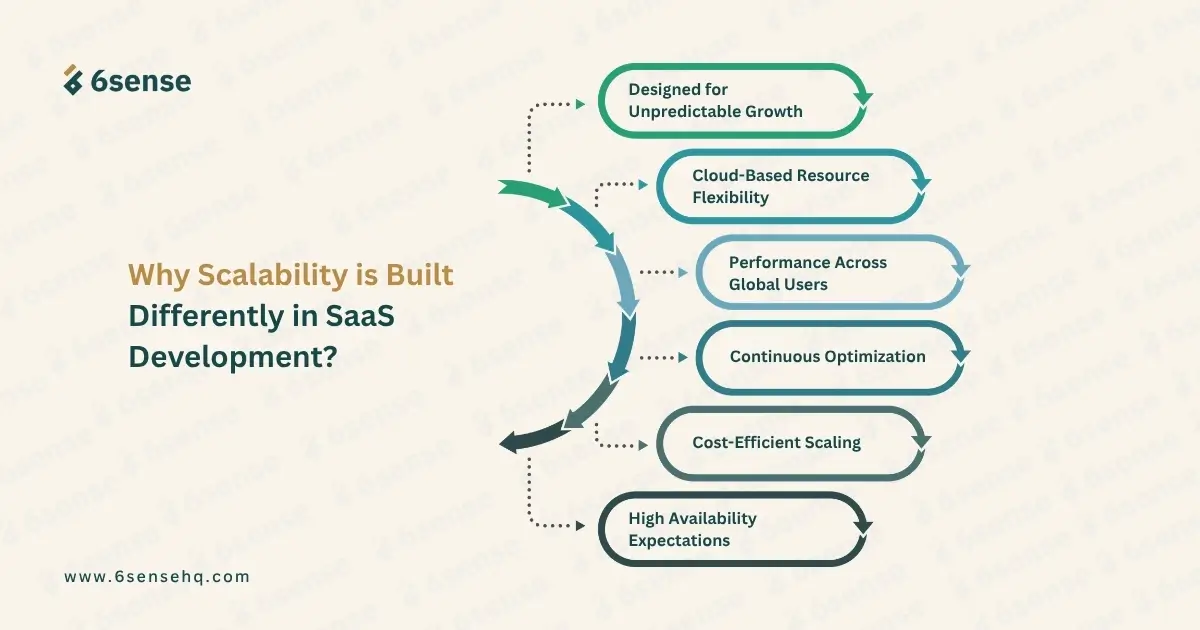
SaaS applications are built to handle sudden spikes in users. Developers design systems that can grow instantly without breaking. Traditional software often struggles here because scaling requires hardware upgrades and manual planning.
The SaaS platform uses cloud infrastructure that can increase or decrease resources automatically. This means developers don’t need to guess future demand. Traditional systems require fixed resources, which can either be wasted or insufficient.
SaaS products are built for users from different regions. Developers focus on performance, load balancing, and uptime. Traditional software is often optimized for a single environment, not global access.
SaaS teams constantly monitor usage and improve performance. Scaling is not a one-time decision. Traditional software scaling usually happens in phases and takes more time and effort to implement.
In SaaS, scaling is cost-effective because resources are shared and optimized. Traditional scaling often means buying more hardware and increasing operational costs significantly.
SaaS users expect the system to work all the time. Developers build for uptime, backups, and failover systems. Traditional software may tolerate downtime since it runs in controlled environments.
Security is one of the biggest concerns when choosing between SaaS and traditional development.
Research shows that cloud environments introduce multiple new attack vectors, including data breaches, account hijacking, DDoS attacks, and malware. These are consistently identified as the most common and severe threats across cloud systems (ResearchGate, 2024).
SaaS providers usually follow strict standards like SOC2, ISO27001, and GDPR compliance. They also follow a shared responsibility model, where the provider secures infrastructure and the user secures access and usage.
Traditional software gives full control over security, which is useful for industries like healthcare, finance, or government systems. However, it requires strong internal expertise.
Gartner predicts that 75% of enterprises will prioritize SaaS data protection by 2028, showing how critical SaaS security has become.
In simple terms, SaaS offers strong built-in security, while traditional systems offer full control but require more effort.
Cost is one of the biggest deciding factors between SaaS and traditional development.
Organizations can reduce infrastructure costs by up to 30% after moving to cloud-based SaaS environments. At the same time, around 32% of SaaS spending is underutilized, showing that cost efficiency depends on proper usage and management (Flexera, 2023).
SaaS follows a subscription model, which reduces upfront costs but adds ongoing expenses. Traditional software requires a high initial investment in licenses, infrastructure, and IT teams.
Hidden costs also matter. Traditional systems require maintenance, upgrades, and hardware. SaaS reduces these costs but may increase over time with scaling.
Many companies report reduced infrastructure costs after switching to SaaS due to shared cloud resources and lower maintenance overhead.
In simple terms, SaaS is cheaper to start, while traditional may be cheaper long-term depending on usage.
Example: Startups often choose SaaS for speed, while banks or defense companies prefer traditional systems for control.
By 2025, 85% of organizations are expected to adopt a cloud-first strategy, reinforcing SaaS as the default choice for new systems (Gartner).
Adobe moved from boxed software to SaaS, eliminating installation friction and enabling continuous updates. Key Difference: SaaS enables continuous delivery instead of version-based releases.
Salesforce proved that SaaS CRM could outperform traditional on-premise systems. Key Difference: Cloud-based SaaS scaled faster and reduced deployment complexity.
Maintenance is where SaaS truly changes the game compared to traditional software development. Traditional systems often rely on upgrade cycles lasting 12-18 months, while SaaS enables continuous updates and near-instant bug fixes (SaaS Forum, 2026).
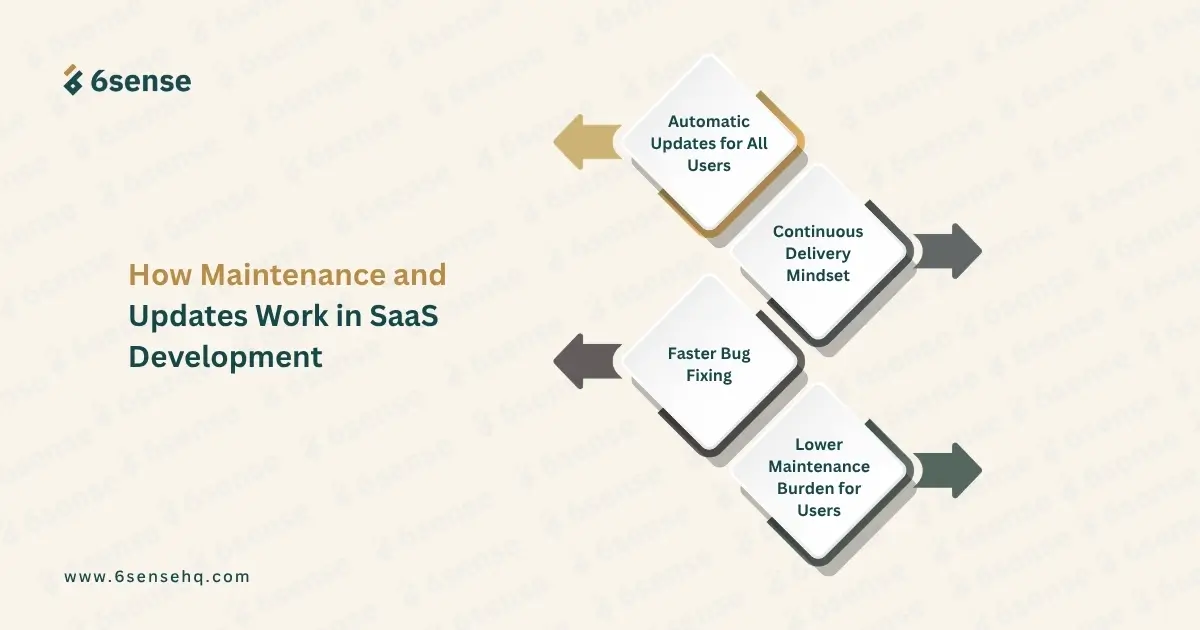
The SaaS development process allows developers to push updates instantly to everyone. Users always get the latest version without doing anything. Traditional software requires manual updates, which many users delay or skip, causing version issues.
SaaS teams follow continuous delivery, releasing improvements regularly. Developers don’t wait months for big releases. Traditional development often follows slower release cycles with major updates instead of frequent improvements.
In SaaS, bugs can be fixed and deployed immediately. This improves user experience quickly. Traditional systems require patches and updates that users must install, delaying fixes and causing frustration.
SaaS shifts maintenance responsibility to the provider. Users don’t manage servers or updates. Traditional software requires dedicated teams to handle maintenance, increasing time and cost.
Customization and control work very differently when comparing SaaS with traditional development models.
SaaS focuses on standardized solutions that work for many users. This means customization is limited, but development is faster and more efficient. Businesses rely on built-in SaaS features instead of heavily modifying the system. In fact, around 81% of organizations have automated at least one business process using SaaS, showing how companies prefer ready-to-use solutions over heavy customization.
Traditional software offers full customization. Companies can shape the software exactly to their needs, integrate deeply with internal systems, and control every detail. But this comes at the cost of time, complexity, and higher development effort.
A key insight developers often share is this: SaaS trades flexibility for speed, while traditional software trades speed for control. Choosing between them depends on business goals and how much customization is truly needed.
SaaS development is not just a technical shift. It changes how software is built, delivered, and improved over time. It focuses on speed, scalability, and user convenience, while traditional development focuses on control, customization, and stability.
Companies like Adobe and Salesforce proved that SaaS removes friction from deployment and allows continuous growth.
The decision comes down to your needs:
Talk to our expert team at 6sense HQ today as we’ve helped 50+ founders make this exact decision, and the right choice always depends on your long-term product vision.
Choosing the right SaaS development methodology is key to growth. Learn how Agile, Lean, and DevOps can help scale your startup.
6 min read

Master the SaaS development process with our step-by-step guide on planning, building, and scaling a successful cloud product.
8 min read

Master the SaaS development process in 2026. Learn about costs, tech stacks, and best practices to build and scale your cloud software.
11 min read